The unnecessary prologue: How to avoid the info-dump trap
I keep hearing that the publishing industry is fed up with prologues.
I keep seeing new novels with prologues get published.
Clearly, the publishing industry is not so fed up with prologues that it won’t publish novels with prologues.
So what gives? Well, I’m not a publisher, but I’m pretty certain that what the publishing industry is actually fed up with is unnecessary prologues.
Prologues are great. I love a prologue. I love writing them and I love reading them. A well-crafted prologue lets you set the scene, fire off an opening hook, drop hints, or provide critical background information that helps readers dive into your story world… if it’s doing its job. The trouble is, the unnecessary prologue doesn’t do any of that. Instead, it takes the form of a hefty info-dump filled with backstory and world-building that nobody asked for and most people won’t stick around to read. It feels more like a lecture or a manual than an invitation into the story.
So, how can you tell if your prologue is necessary? Let’s look at what makes a prologue necessary (and exciting), how to spot when yours isn’t pulling its weight, and how to fix or cut it with confidence if it turns out that your prologue isn’t ticking the right boxes.
Contents
What is an unnecessary prologue?
Let’s start with a definition. Simply put, an unnecessary prologue is a chunk of writing at the very start of your book that dumps a load of information—about characters’ histories, political systems, magical rules, or ancient wars—that your reader has no emotional investment in yet. It’s an info-dump, basically—right at bit where you need to catch your reader’s attention.
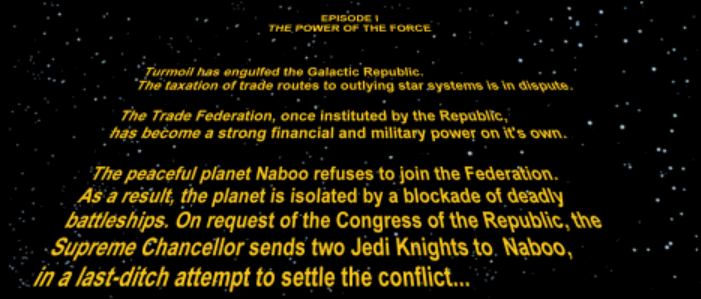
Think about the opening crawl of Star Wars. (Yes, I’m going there.) Specifically, the opening crawl at the beginning of The Phantom Menace. It’s not the best loved film in the franchise for a whole host of great reasons, so hardly anyone ever mentions the prologue—which is a shame, because it’s a prime example of what I’m talking about here.
“Turmoil has engulfed the Galactic Republic,” it begins. Great start. Turmoil is basically another word for conflict, so we’re opening with a hook. But then it adds, ”The taxation of trade routes to outlying star systems is in dispute,” and the wheels come right off.
There’s no way to make a trade route tax dispute compelling in a prologue. It could comprise the central conflict of the narrative, for sure, because it brings with it a whole host of deeply human issues: there are livelihoods on the line, there are real people less able to trade and purchase necessities and support themselves and their families. Focusing on that human struggle, or the shadowy powers behind it, or the people pushing back against it is absolutely the stuff that narratives are made of… but we don’t have a narrative yet. We have a prologue, which sits outside of the main narrative, and it’s telling us—clinically, detached, devoid of context—rather than presenting us with any reason to care.
“Hoping to resolve the matter with a blockade of deadly battleships,” the scroll continues, “the greedy Trade Federation has stopped all shipping to the small planet of Naboo.”
Okay, a blockade of deadly battleships is more interesting than a trade dispute, but it immediately loses its punch when we discover that, again, this is more about trade. The deadly battleships have been deployed to stop trade from happening. To a planet we’ve never encountered before. We know nothing about this planet, have never met a Naboo inhabitant, and we have no way of knowing how poorly or otherwise they’re faring as a result of this trade route blockade. Are they starving? Or self-sufficient enough to weather the storm? Who knows? And there’s still no face to put on any of this conflict. It remains entirely abstract.
“While the congress of the Republic endlessly debates” —big yikes; the only thing less exciting than a trade route tax dispute is an endless debate about it— “this alarming chain of events, the Supreme Chancellor has secretly dispatched two Jedi Knights, the guardians of peace and justice in the galaxy, to settle the conflict…”
And here we leave the scroll and enter the action, with an expository opening scene that… kind of restates the core information in the prologue, as the two Jedi Knights in question encounter the blockade in question around the planet in question after hearing from the Trade Federation in question who allude to the blockade in question being perfectly legal—which we know it is, having read the scroll, but which is a detail that would be much more compelling if it came as a surprise (Huh? These battleships encircling a planet are all legal? What’s going on?)
Of course, the primary reason for the scroll in the Star Wars franchise is that it’s an iconic feature of the Star Wars franchise, and taking a pot shot at The Phantom Menace feels… ungenerous, to be honest; it’s like shooting fish in a barrel. But equally, it’s a prime example of why adding a prologue for the sake of adding a prologue contributes very little to your narrative at best… and at worst, can actively harm it.
Imagine this was a novel by an author you’d never heard of. Imagine it opened with a couple of pages explaining what was about to happen and the dry history behind it. Are you going to keep reading? That’s how the unnecessary prologue harms your narrative: by creating a barrier to entry before you’ve even got started.
Why do writers fall into the info-dump trap?
If you’re reading this and thinking, “Uh-oh…” don’t worry. This is very common among emerging writers, for a few reasons:
- Author needs clarity: Often, an info-dump prologue (or any info-dump, really) is actually what I call “author notes”—the stuff you as a writer need to figure out yourself so you can tell your story properly. You’re discovering this information as you’re writing it, and writing it to discover it. It belongs in your earlier drafts, because you needed to write it to uncover it yourself. But once you’ve uncovered it, this information weaves its way through the rest of the narrative, and can—and should—be lifted out in subsequent drafts.
- Pressure to explain everything upfront: There’s this nagging fear that readers won’t understand or appreciate your story without knowing every detail. So writers cram in history lessons or complex rules early on “just in case.”
- Love for their creation: You adore your world and characters—and rightly so. You’ve poured your heart and soul into making this place and the people who live in it come to life. But sometimes this enthusiasm makes us want to overshare, or makes it harder to discern what’s truly relevant and necessary, and what’s background information that ought to remain subtextual in the final draft.
All of this is especially true of prologues. If you, the author, have taken the time to devise an elaborate family tree for your storyworld’s royal dynasty in order to remain consistent throughout the narrative, for example, it seems only reasonable that your reader would need to have all of that information available to them too, right? If the reader doesn’t understand the complex web of history that’s led inexorably towards the moment of crisis that spurs your narrative into action, then they’re surely missing critical context, right?
Well… no. Maybe a little bit yes, but mostly no. Your reader, encountering your narrative for the first time, has no reason to care yet about any of this history. You give them a reason to care by introducing the present day situation, the conflict your protagonist must face, and the stakes if they fail. Then, and only then, will your reader be primed to want to understand more about the historical context, and you can drip-feed that as necessary throughout the novel as you keep your story moving relentlessly forward.
But a reader needs to invest in the now before they’ll care enough to want to understand the then.
“A reader needs to invest in the now before they’ll care enough to want to understand the then.”
What makes a good prologue?

So info-dump prologues are basically a big no. But that’s not the same thing as saying all prologues are a big no. Some novels actively need a prologue in order to make their opening act work, and that’s fine. These are necessary prologues, and you can tell the difference by the way it:
Is directly relevant to the story
A necessary prologue introduces action or events that tie into the main conflict or themes of your novel—even if those events happen outside the main timeline. It might show a key moment that sets everything in motion or reveal something crucial about the stakes or characters.
Sparks curiosity and questions
Rather than answering all the “whys” and “hows” upfront, a necessary prologue teases readers with just enough information to make them want to keep reading. It should raise questions that the story will answer later, not hand everything over on a silver platter.
Feels integral to the plot
A necessary prologue is part of the core storyline. It shouldn’t feel like you’re delaying the beginning with a history lesson. Instead, it should flow naturally into the main plot.
Shows action or conflict
Even if it’s brief, some form of conflict or tension engages readers immediately. This could be an interpersonal drama that precedes the protagonist’s main dilemma (but which impacts on how the protagonist approaches the central conflict). It could be an event that raises an initial question that will be answered by the narrative. It could be an earlier precursor to the main conflict—for example, a murder mystery that’s rooted in a much earlier crime might start with a prologue showing the long-ago event before opening with the protagonist’s present-day normal world that’s about to be disrupted by the central murder.
Remember, not all stories need a prologue, and that’s absolutely fine. The goal is to add a prologue only when it genuinely serves your story.
How to decide if your prologue is necessary
Here comes the litmus test. How can you tell whether your prologue is a vital part of your novel or just author notes disguised as narrative? Here are some practical questions to ask yourself:
- Does this move the plot forward? If you took out the prologue, would readers lose important information they need to understand what happens next?
- Does it introduce key characters or conflicts? Or is it mostly background information? If there are characters in the prologue, do we ever meet them again?
- Would skipping it confuse or frustrate readers? If not, it’s probably unnecessary.
- Does it spark curiosity and make readers want more? Or does it feel like there’s going to be a pop quiz down the line worth 30% of your overall grade?
- Could this information be revealed through character interactions or events within the main story? Showing is—almost without exception—better than telling. Unnecessary prologues are very often all about telling.
If you’re in any doubt at all, try sharing your prologue with beta readers without any explanation and ask for their honest feedback. Sometimes fresh eyes spot issues we miss because we’re so close to our work.
You can also try temporarily removing the prologue and starting with chapter one—does the story still hold up? If yes… your prologue is probably unnecessary.
The problem with “call-ahead” prologues

One quick special mention here for a specific type of prologue that I call the “call-ahead” prologue. This is where a story opens with a flashforward—often a dramatic or climactic moment from near the end of the novel—in an attempt to hook the reader immediately. The rest of the narrative then unfolds linearly, leading up to that very scene.
On the surface, this might seem like a clever way to build suspense. After all, showing the stakes early can create intrigue. But in many cases, especially when used as a crutch rather than a deliberate narrative choice, a call-ahead prologue can come across as lazy storytelling.
Why? Because if your story’s hook relies entirely on events that happen after (or at) the climax, rather than those that precede or build toward it, it suggests the material leading up to that moment isn’t strong enough on its own. Instead of crafting compelling scenes and conflicts that engage readers from the start, you’re essentially saying: “Look at this exciting moment! But don’t worry about how we got here; just wait.”
This approach undermines narrative tension and diminishes investment in character development or world-building. It also misses opportunities to explore rich parallel action or alternative perspectives within your storyworld—elements that could make for much more engaging and organic prologues.
It’s worth distinguishing these “call-ahead” prologues from openings in stories told fatalistically or teleologically. These $10 terms come from philosophy and literary theory, so bear with me for a quick explanation:
- Fatalistically told stories begin by revealing an outcome or event (often tragic) that is inevitable, then proceed to show how characters arrive there. The sense is one of fate or destiny unfolding.
- Teleologically told stories are structured around purpose or end-goals; they start with an effect and work backward through cause and motivation.
A classic example is Donna Tartt’s The Secret History, which opens by referencing Bunny’s death before unpacking how events led there. Because the story embraces a fatalistic perspective—the outcome shapes everything—it feels natural and intentional.
By contrast, many “call-ahead” prologues simply flash forward without this framing context or narrative purpose. They tease readers with an event but don’t justify showing it so early—except as bait. This disconnect can leave readers feeling manipulated rather than intrigued.
If you find yourself tempted by a call-ahead prologue, consider whether your story’s opening moments before that climax can stand on their own merits. Could you instead explore scenes from different viewpoints? Introduce conflict earlier? Or reveal parts of your world gradually?
Strong hooks don’t need to jump ahead in time. They need to immerse readers immediately in stakes they care about—and those usually arise from what happens before the climax.
How to fix or cut an unnecessary prologue

So you’ve identified that your prologue is… not doing your novel any favours. No worries! Happens to the best of us (and I mean that sincerely—you should see some of my early drafts). Dealing with an unnecessary prologue is usually a fairly easy fix, in the grand scheme of things. Here are a few possible approaches:
- Rewrite your prologue with focus on action and relevance: Maybe your novel needs a prologue, just… not this one. At least, not the way it’s currently constructed. The good news is, a great prologue is usually no more than two or three pages long, so there’s not much new writing to do here. Start by stripping out anything that doesn’t directly relate to the story’s conflict or themes. But don’t delete the text you cut—it’s valuable world-building information and you may need it as you start to…
- Integrate world-building more gradually: The key is to get your reader to care about this information, which you do by getting them invested in the plot, the stakes, and the characters. A lot of the world-building information that often goes into an unnecessary prologue will have already made it into your novel proper—that’s just how author notes work—but if you need to make specifics super clear, find the point at which the reader requires this information (as in, the story will no longer make sense without it) and weave it in there instead of front-loading it into a prologue.
- Use other tools for exposition: Flashbacks, memories, letters, news reports, even dialogue—these are the kinds of expository information chunks that integrate readily into a narrative in progress. You can then sprinkle your exposition strategically at appropriate moments rather than dump it all on page one.
- Trust your reader: They can make sense of subtext much more fluently than you’re giving them credit for. And readers love discovering things bit by bit—the act of consuming a narrative is basically an act of information hunting. Questions and uncertainty are what keeps us turning pages. Don’t underestimate your reader’s patience or their intelligence (or your ability to drop narrative hints).
- Cutting isn’t failure—it’s progress: It’s natural to feel attached to your opening pages—they’re often where you first put pen to paper. But sometimes in writing we have to just murder our darlings for our stories to breathe. Don’t delete the sections that you snip—create a folder or a document where you can cut and paste these discarded pages (I call mine the “Cutting Room Floor”). For one thing, you never know when you might need the exact turn of phrase that you were so delighted to write and which cost you so much heartache to remove: it might not have a home in this story, but it might be just the thing in a story you write in the future. And for another thing, these pages are a milestone on your writing journey. One day, you’ll look back on them with nostalgia and realise just how far you’ve travelled.
Final thoughts
The unnecessary prologue is a common stumbling block but easy enough to overcome once you know what to look for. And your story will unquestionably be stronger without it.
Remember, a prologue is a tool, not a rule. It should serve your story’s needs and your readers’ experience—not the other way around. Keep your focus on storytelling first—showing rather than telling—and trust that the world you’ve created will reveal itself beautifully when you let it unfold naturally. The best stories are those that keep readers hooked from the very first page, not overwhelmed by pages of exposition.
Happy writing!

Have you ever met an info-dump prologue in the wild? Let me know in the comments!
Read next