Should you use unconventional dialogue formatting in your fiction?
The short answer is: absolutely. If that’s your thing, if it fits your voice, if your genre of choice supports (or could be persuaded to support) a little bit of boundary-pushing, if your readership is up for shaking things up a bit — then yes, you should embrace that with your whole creative self.
But we’re not here for the short answer. Because, while the short answer is valid, it still contains a lot of “ifs.” And what if the answer to one or more of those “ifs” is “maybe, but maybe not” or even “it depends…”?
So let’s look at the longer answer. It’s more nuanced. I won’t promise that you’ll have made a decision by the time you’ve finished reading, but I will promise that you’ll have a better idea of what formulating an answer to this question actually involves.
Contents
A brief history of dialogue formatting

I promise this is relevant. Because the whole question of where the comma goes and the double-or-single-quotation-mark debate is very much a modern phenomenon.
That’s not really surprising, given the fact that the novel as a narrative form is only around 300-ish years old (in western storytelling tradition, at least) and it’s been in a state of near-constant evolution ever since. But the fact is that until around 400 years ago, there was no universally recognised symbol in written or printed text that indicated direct speech.
This fascinating article by Keith Houston takes a deep and thorough dive into the history of how we, as a species, collectively decided that “ and ” (or ‘ and ’, if you prefer; this is — unusually, perhaps — one grammatical hill I’m not willing to die on) are how we can tell that a person on a page is speaking. Various markings have seen service, over the centuries, as speech designators — as well as the (more common) technique of not actively distinguishing between speech and regular prose, and leaving it to the reader to work it all out from context. The advent of the printing press was heavily involved in the push towards a standardisation of format, of course, because when you’re going to produce something at that kind of scale, you need a certain amount of uniformity. But it was still another few hundred years before the concept of direct speech became so embedded in narrative form (to whit: the rise of the novel) that a more formalised arrangement was necessary.
“Eschewing the paraphrased, reported speech favored in earlier romances,” says Houston, “the new breed of novelists presented readers with their characters’ unvarnished words, and with this new directness came a need to separate speech from narration.” (source)
That’s not to say that the quotation mark was immediately and unanimously accepted. Authors and presses continued to experiment with paragraph breaks, italics, stage-play-like character: speech formats, and more. But, by the beginning of the 19th century, the inverted comma arrangement had become more or less standardised.
And once something becomes standardised, standards of use have a tendency to follow. Once there’s a general agreement on the “right” way to indicate speech… it also becomes possible to do it “wrongly.”
And so here we are.
So, does it even make sense to talk about “unconventional” dialogue formatting?

Well… yes. It may be a relatively recent invention, but so is the Latin alphabet, in the grand scheme of things. The turn of the 19th century is more recent than that, but it’s definitely historical enough that the standards established at that time have risen to the level of convention by now. When we’re talking about unconventional dialogue formatting, we’re talking about layout and punctuation that differs from the standard that’s been established for hundreds of years at this point, no matter what did or didn’t come before.
A more useful question is how we can define it.
“When we’re talking about unconventional dialogue formatting, we’re talking about layout and punctuation that differs from the standard that’s been established for hundreds of years.”
What counts as unconventional dialogue formatting?
It’s much easier to define conventional formatting than unconventional, of course. Conventional formatting is basically just one thing. Unconventional formatting — being… well… everything else — encompasses an enormous range of approaches.
It’s probably easiest to look at how some of the greats of modern literature have staked out their ground.
Sally Rooney
Sally Rooney’s possibly the most famous author to reject dialogue formatting conventions in recent times. Rooney typically omits quotation marks altogether and integrates dialogue directly into the text, with paragraph breaks signalling a change of speaker. Here’s an excerpt from her novel Conversations With Friends:
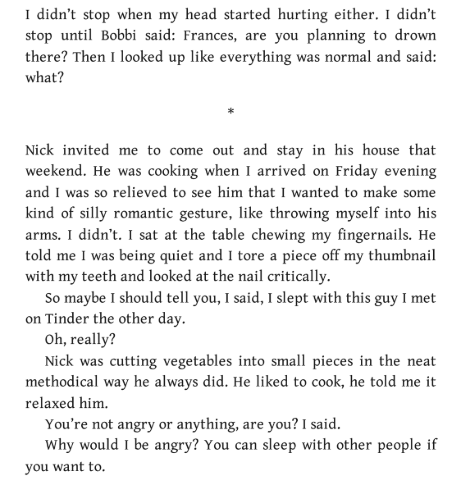
Notice how, in the top paragraph, both Bobbi’s and Frances’ dialogue blends into the surrounding prose. Frances’ final “what?” is separated from the introductory actions (and indeed Bobbi’s preceding speech) by only a colon.
Cormac McCarthy
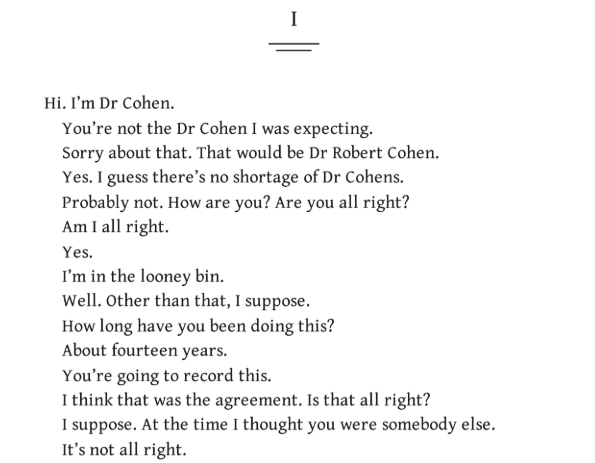
Another author who famously eschews any kind of distinguishing punctuation in his dialogue. The opening section of his novel Stella Maris, below, drops the reader directly into an active conversation with neither quotation marks nor speech tags, so the reader is left to infer from cues in the dialogue itself who is speaking and when, how many speakers there are, and where and why the discussion is taking place.
James Joyce
Full disclosure: I’ve never read any Joyce, nor do I expect this to change. But we can’t discuss unconventional dialogue formatting without discussing the guy who elevated unconventional anything formatting to an art all of his own.
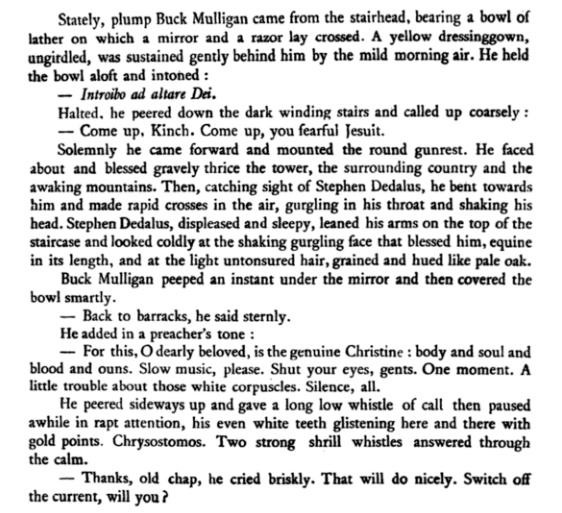
Joyce’s writing explores ideas of the fluidity of thought, self, and interiority, and his unconventional approach to punctuation (not just around dialogue) reflects that aim. He deliberately blurs distinctions between thought, speech, and narration — of which his use of the em-dash as an indicator of direct speech is perhaps his least challenging device. Here’s a passage from the start of Ulysses, in which it’s pretty clear who’s talking and when their dialogue stops, despite there being not a quotation mark in sight:
Elsewhere, though — as in Molly Bloom’s famous closing monologue from the same novel — Joyce omits not only dialogue punctuation but… well… all punctuation. Admittedly, this is not conversational speech; this is a character’s chaotic inner monologue, and the patterning is designed to evoke the way our thoughts skip frenetically from one place to another. But it’s speech of a sort, and, elsewhere, we would typically expect to see internal monologue — direct internal monologue, at least — formatted similarly to spoken dialogue.
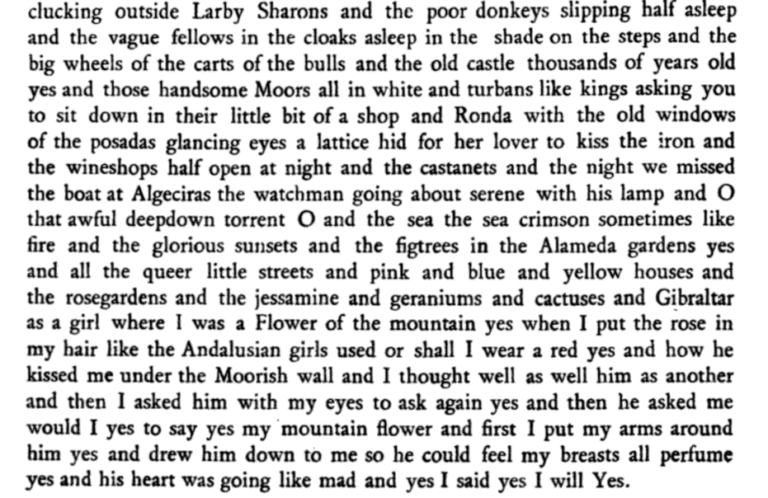
Nary a comma to be had, much less a paragraph break. And speech marks? Forget it. Readers tend to either adore this or loathe it; there’s very little middle ground with this kind of literary nonconformity. It’s certainly made for some lively academic debates.
Roddy Doyle
Like Joyce (a fellow Dubliner — though there the similarities largely end…), Doyle’s a fan of the em-dash as a notation for his characters’ dialogue. But where Joyce is using his punctuational fluidity to reflect the fluidity of consciousness, Doyle’s writing actively seeks to closely mimic conversational patterns, especially the rhythm and idiom of Dublin vernacular. Here’s a section from The Snapper:
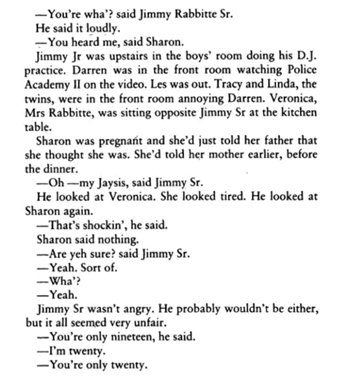
Often, when authors choose to push back against conventional dialogue formatting, it’s about blurring the lines between prose and dialogue; about creating a sense of immediacy; about breaking down the divide between story and what can feel like separate, reported speech — more news article than narrative. Sometimes, it’s about challenging norms and pushing the boundaries of what’s considered “possible” in the experience that literature can provide. Sometimes, it’s experimentation for the joy of discovery.
It’s always strategic, though. No author rejects conventional dialogue formatting by accident. We need to understand the rules before you can break them.
What you need to know about conventional dialogue formatting before you decide not to use it
Punctuation in dialogue is one of those grammatical strictures that we tend to learn once, briefly, in English class and then never really think about again… until the novel-writing bug attacks. And, annoyingly, it’s one of those rare aspects of the craft of writing where it’s possible to be objectively wrong: there are rules, they’re universally adopted in the western canon, and a surefire way to get on the wrong side of an editor or agent is to put the comma outside of the speechmarks once too often. So, there’s no denying that the concept of just… chucking it all out of the metaphorical window can be quite appealing.
But the thing about Joyce’s wild 22,000-word Ulysses-ending stream-of-consciousness monologue (see above) is that he knew exactly what he was doing, and why, when he wrote it. It wasn’t that he was ignoring punctuation, it was that he was actively, deliberately choosing to eliminate it, and that’s a critical difference. Removing all the full stops is only an act of literary genius if you know why they exist in the first place — otherwise, you’re just writing a really, really, really long run-on sentence.
The same is true for removing the punctuation around dialogue. So, here’s why literature has collectively agreed the current convention is, on balance, a good thing, so you can make a fully informed decision about whether or not to push back against it.
Reader clarity
One of the reasons dialogue punctuation has evolved the way it has is to minimise reader confusion. How important is that to you, as a writer? That’s not an idle question: some writers — like Joyce, for example, but very definitely not limited to Joyce — actively want their reader to have to work for their narrative. Likewise, some readers actively choose fiction that challenges them. So, some questions you might want to ask yourself when you’re deciding whether to choose unconventional dialogue punctuation might be:
- Are your prospective readers likely to be pro- or anti- when it comes to a “challenging” reader experience?
- When you consider your literary ambitions, would you be happy or frustrated if your writing was labelled as “challenging”?
- Is linguistic freedom more or less important to you than creating a clear consensus of meaning with your words?
- Do you want your readers to debate what you “really meant” or do you want to make sure they follow your direct line of thought?
- What are the genre expectations around the level of challenge that your readers will typically tolerate?
There’s no value judgement and no right or wrong with any of these questions. And there’s also quite a lot of wiggle room on the answers too: that last question, for example, is wide open in most genres — compare, for example, the textual complexity of, say, The Martian versus Solaris to get a sense of how there’s no one-size-fits-all answer in science fiction. Most other genres will have a similar spectrum.
Only you know what the answers are here.
Character voice
One of the ways in which reader clarity is impacted by unconventional dialogue formatting is in terms of identifying at a glance which character is saying what. Now, I’d argue that having a well-defined and identifiable “voice” for each character is best practice anyway when writing fiction, but it becomes all the more important when you’re relying on a character’s words, intonation, phrasing, vocabulary, and verbal delivery style to keep the reader straight on who’s saying what.
The level to which this is a consideration depends a lot on how far you plan to move away from conventional dialogue, of course. Roddy Doyle’s em-dash designation leaves very little room for confusion; Molly Bloom’s monologue, on the other hand, would be near-impossible to parse if it involved more than one person. But also consider that conventional dialogue’s not a silver bullet here either — the value of “he said” in clearing up speaker uncertainty diminishes proportional to the number of “he”s that are speaking in any one conversation. I’ve definitely lost track of which “he” was doing the saying in multi-speaker exchanges, conventional dialogue notwithstanding, so, while this question should form part of your decision-making process, it’s not necessarily the most important point to consider.
White space
This one is a bit niche, but don’t underestimate it. White space describes the parts of a page that don’t contain any text, and it’s more important than you might think. Because of the way our vision works, the human eye tends to lose track of its place on the page when reading large chunks of text. The technical term for this return-sweep saccades: the sweeping movement that takes the eye from the end of one line of text to the beginning of the next. When there’s little to visually differentiate between one line and another, return-sweep errors become more common, which is when a reader loses their place in the paragraph. We all know what that feels like, and it’s not a great reading experience. Plentiful white space on a page minimises the risk of these return-sweep errors occurring — and conventional dialogue formatting favours plentiful white space. Is that a reason to abandon non-conventional dialogue formatting? Absolutely not. But it is something you need to know about when making a decision.
Editors and publishers
There’s no getting away from this fact: the decision to use unconventional dialogue formatting is going to annoy some readers. And some of them will be the people you need to impress to get a publishing contract.
Should this factor into your decision? Yes and no. On the one hand — no, because there’s no way to write a novel that impresses absolutely everybody. You will always, always, always have people who don’t like your writing style. No matter what you do, no matter how meticulously you craft your plot, develop your characters, polish your prose, you can never achieve universal appeal. Dan Brown’s sold millions of copies of all of his books, and he regularly gets critically excoriated the way they’re written. James Joyce is considered a giant of modem literature and I just spent several paragraphs above taking a pop at him. I love a Roddy Doyle; I can’t get past the first page of a Cormac McCarthy. All of this is subjective and trying write a novel that is unconditionally adored by all is a surefire way to psych yourself out of ever writing a word. So, no, it shouldn’t factor into your decision, because you should write the novel that you want to write, the way you want to write it, and not try and make it conform to anyone’s standards but your own.
But… also, yes. Because, rightly or wrongly, if you aspire to a traditional publishing contract, you are going to have to convince multiple industry professionals to not only read your work, but read it and enjoy it enough to invest money in bringing it to market. Now, editors and publishers are readers too, and a significant quantity of readers have amply and consistently demonstrated that they’re more than happy with unconventional dialogue formatting, which means that (a) there’s a demonstrable market for it and (b) multiple industry professionals are keen to see this kind of writing in print. It will, ultimately, come down to whether or not your writing style as a whole captures their hearts and minds — which, given that you’re confident enough of your prose that you’ve taken the decision to push the boundaries of convention a little, seems like a reasonable proposition.
But we’d be kidding ourselves if we pretended that it won’t put some editors and publishers off. And that might be a dealbreaker for you.
Final thoughts
Anyway: told you it was a long answer. Told you it was nuanced, too. If you’ve read to the end and you’re feeling no clearer about the path you want to take, that’s okay. It doesn’t need to be a quick decision — just as it was when you were considering what POV to write in, whether to go with present or past tense, where to start your story, and so on, sometimes there’s an obvious answer that jumps right out at you, and sometimes it takes a bit of thought and experimentation. (I once junked an entire first act when thought and experimentation didn’t end up working out, and I have no regrets).
But if you’re still on the fence and want a simple answer? I say: yes. Yes, you should use unconventional formatting if it appeals to you and you have even the tiniest inkling that it’s going to serve the story you want to tell. Writer intuition is a powerful thing, and I’ve learnt over the years to listen to it, even if I don’t quite understand why it’s nudging me in a particular direction. Your creative voice is yours, and it’s unique, and it’s powerful. Never underestimate that.

What’s your favourite example of unconventional dialogue in fiction? Let me know in the comments!
Read next