Do You Need to Use Chapters In Your Novel?
You sit down to write your novel. You open up a new document on the computer, or turn to the first page of a crisp new notebook. You consider for a moment, then compose the first words.
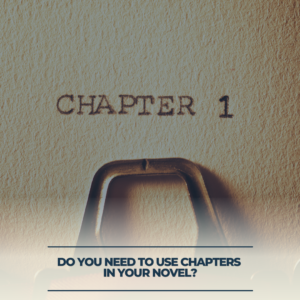
Chances are, those first words are going to read: CHAPTER ONE.
But does that have to be the case? Cormac McCarthy didn’t use chapters in The Road. Sir Terry Pratchett (my favourite author of all time, and whom I firmly believe to be one of the greatest writers of the past several generations) famously “just never got into the habit“ of them — though he did make an exception in his books for younger readers (and, as a stylistic choice, in his Moist von Lipwig stories). Strictly speaking, there’s no requirement for authors to break their novel-length fiction into chapter-sized chunks, so the short answer is no: you don’t have to use chapters at all.
But, as always, the longer answer is a bit more nuanced…
Contents
Team No: the argument against chapters

Cormac McCarthy was never one for cluttering a page unnecessarily — he admired James Joyce’s minimalist approach to punctuation and once told Oprah Winfrey that he preferred not to “blot the page up with weird little marks.” He was a writer with a very clear vision — narratively and stylistically — and his books were uncompromising in his pursuit of that goal. The Road is a relentless walk through a desolate wasteland: there’s no respite, no relief for its unnamed protagonist and his son, and McCarthy wanted his readers to experience that unending, exhausting journey with them. Chapter breaks would have introduced a kind of relief valve for the reader; a natural break to pause and reflect.
We’ve all been there, I think, as readers — I once stayed up until dawn reading The Lord of the Rings because the Fellowship had made it to the mounds of the barrow-wights and I couldn’t put the book down until I’d seen them safely out the other side… at the end of the chapter. McCarthy did not want that for his readers. The man and the boy of The Road don’t have the luxury of pressing pause on their adventures at the end of a particularly stressful sequence. Allowing the reader to do so would be untrue to the story that McCarthy wanted to tell.
Maybe you’re writing from a similar place of absolute authenticity, post-apocalyptic or otherwise: you don’t want your reader to have the comfort of easily choosing to look away, because that would not be true to the story you’re telling. Or maybe it’s less about involving the reader viscerally in your story-world and more about the story itself: maybe your story needs the freedom to unfold without interruption. Some narratives flow like a river or an uninterrupted dream, and forcing an artificial break every 3,000 words or so would kill that momentum. Some emotional arcs need room to evolve without the formalised, constrictive beat of an internal chapter structure. Some stories are simply meant to be told all in one go.
As the great Sir Terry once said, “life does not happen in regular chapters, nor do movies.” And he has a point: imposing a chapter-by-chapter structure on a narrative imposes an order onto events that’s completely absent in real life. If we’ve turned to fiction to help us understand ourselves better, to get an insight into the world and the people within it, to tap into some universality of human experience — why would we want to dilute that message by breaking it down into more manageable chunks? Why would an author want to treat their readers as though they need the message diluted in that way?
Team Yes: the argument for chapters

With all that said, “tapping into some universality of human experience” is not the only reason we read books. I’m a fiend for zombie fiction, and I’d be prepared to bet good money that no human living or dead has ever actually experienced a zombie attack. Great stories have the capacity to transport us beyond human experience. Sometimes, we turn to stories to escape human experience altogether.
Readers use chapters in different ways. The “one more chapter before lights out” method is a reading practice we learn as children — and it’s one of the reasons Terry Pratchett did use chapters in his stories for younger readers: because, he says, chapters “allow the parent to say ‘I’ll read to the end of the chapter and then you must go to sleep’.” We don’t tend to consume novels in one sitting; we consume them over days and weeks, and chapters help break up that reading experience into discrete sections. As I’ve devoured every Terry Pratchett book in existence (many of them more than once), I feel well qualified to say this: it’s not easy, when immersed in the Discworld, to decide on a place to stop for the night.
There’s also the question of structure itself. For better or worse, at this point in human history, we have narrative structure down to a fine art. We’re trained from our earliest encounters with story to expect an ebb and flow of narrative beats: a beginning, a story-heavy middle, a conclusive end. Chapters embody this structure at a micro-level: each individual chapter is its own self-contained mini-narrative with a beginning, a middle, and an end. Even though it forms part of a larger whole (the novel itself) each chapter is a discrete unit of dramatic action, and each chapter leaves the reader in a different emotional or narrative state than where they started. While you absolutely can create the same hook–complication–change–cliffhanger effect without breaking down your narrative into chapters, chapter divisions act as an organising principle, helping the author (and reader) pace out the continuous flow of the “Rising Action” second act. They simply make the story structure more manageable, for both the author and reader.
Chapters also facilitate pacing. You’ve probably heard the advice that a chapter should be around 3,000 words long (and I’ve used it in this article as a guideline, too), but that’s nonsense. Anything longer than 3,000 words is probably pushing the limits of your reader’s tolerance (remember, they’ve probably got work tomorrow and they can’t go to sleep until they arrive at a chapter break…), but there’s no hard-and-fast rule here, and there’s definitely no minimum word count. I’m ambivalent about the Twilight series for a lot of reasons, but those empty chapters in New Moon did an incredible job of conveying the black flatline of depression, in a way that any amount of words simply couldn’t capture. In thrillers, short, choppy chapters work to speed up the tension and action; in fantasy, longer chapters can help to anchor a reader in an unfamiliar world and create a sense of immersion. Strategically combining longer and shorter chapters helps vary the pace, providing the push-pull of a narrative gathering speed and giving readers a chance to catch their breath, consolidate the information they’ve uncovered, and prepare for the next round of ratcheting tension.
And finally — and this is nothing to ignore — the publishing industry, by and large, expects chapters. For better or worse, chapter divisions are standard in the modern novel, and you might well find yourself in an uphill struggle to convince agents and publishers (if you’re going down the trad route) or readers themselves (if you’re self-publishing) to take a chance on a book without chapters. There’s a bit more leeway in, say, literary or avant-garde fiction, but even then, you’ll need to be prepared to justify the decision to forgo chapters as a deliberate, artistically necessary choice — and be prepared for others to disagree. Nothing is fixed, and the industry is as fluid and shifting as ever — and hugely successful authors like Pratchett and McCarthy provide a helpful rallying point for an argument against the chapter structure — but the simple fact is… chapters are popular for a reason. And editors and publishers like popular, because it’s a safer bet for selling books.
“For better or worse, chapter divisions are standard in the modern novel, and you might find yourself in an uphill struggle to convince agents and publishers to take a chance on a book without chapters.”
Final thoughts: chapters or no chapters?

Ultimately, as with all elements of the craft of writing, the decision about whether or not to break down your novel into chapters will rest on three main factors:
- Your preference as an author
- The preferences of the demographic you’re writing for
- Your own authorial voice
But — personally? I like chapters. I like experimenting with chapter structure (like I did with my “sub-chapters” in Edge of Heaven, which was in turn strongly influenced by what Ben Elton did in This Other Eden), but, fundamentally, I find chapters a powerful organising force and an active support to the flow and evolution of story.
I also find their rhythm reassuring. We experience life in one long, unbroken moment, without foreshadowing or neat little arcs, and we’ve tended to impose order on that chaos by filtering it into predictable narrative pulses in the stories we’ve told ourselves to make sense of our world. Anything can happen at any time in the real world. Narrative structure is one of our psychological defence mechanisms against that, and chapters are one of the supports that underpin that structure. I find that comforting. Your mileage may vary.
So… do you need to use chapters in your novel? I’d argue that “need” is probably not the right word. It implies an obligation to something other than the story itself, and that’s the wrong place to start. Your only obligation is to the story, and only you, as its writer, can say with authority what that story requires. If it requires the space to flow freely, without arbitrary breaks in the narrative rhythm, then that’s your answer.
But if you’re not sure, or you’re in two minds, or you’re worried that using chapters is in some way formulaic, or you’re in any doubt at all, I’d say that’s an answer in itself. There are a few good reasons not to use chapters — but at this moment in our literary history, there are more reasons to use them.
I’m Team Chapters, all the way.

Read next